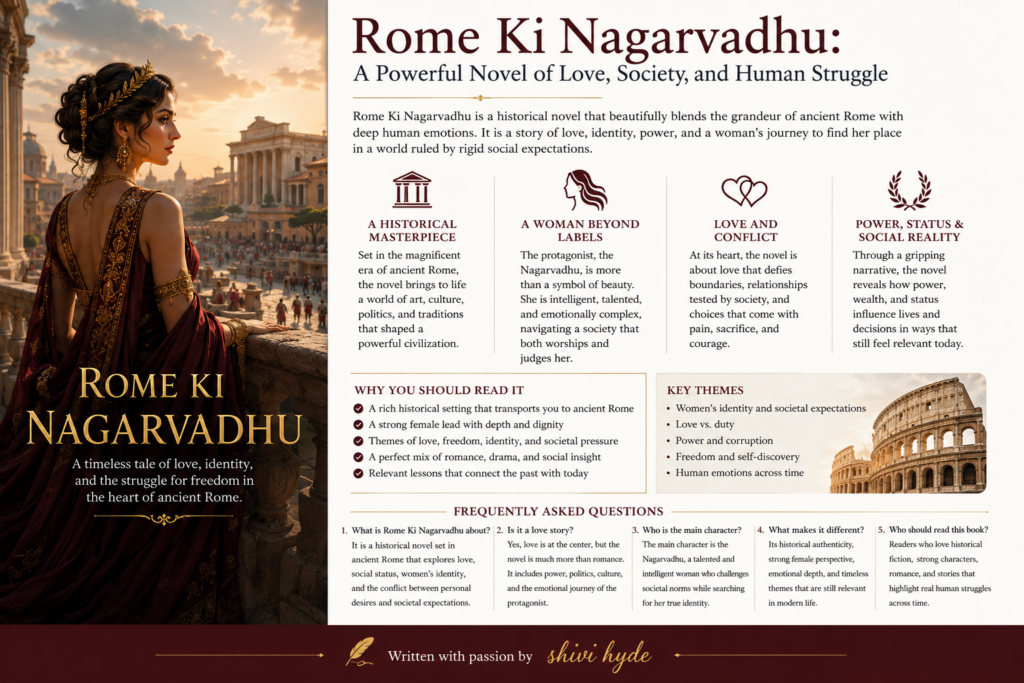
Rome Ki Nagarvadhu: A Powerful Novel of Love, Society, and Human Struggle
Rome Ki Nagarvadhu is a novel that takes readers into a fascinating world shaped by history, power, love, social customs, and human emotions. Set against the backdrop of ancient Rome, the novel offers more than a historical narrative. It explores the lives of people caught between personal desires and the rigid expectations of society.
Historical novels often attract readers because they allow us to experience another era through characters, relationships, conflicts, and cultural traditions. Rome Ki Nagarvadhu does this by presenting a world where status, beauty, relationships, politics, and social reputation can influence the course of a person’s life.
The title itself creates curiosity. The idea of a “nagarvadhu”—a woman associated with the cultural and social life of a city—immediately raises questions about identity, dignity, freedom, and the position of women in ancient society. Through this central idea, the novel encourages readers to look beyond the glamour of the past and understand the difficult realities that existed beneath it.
What Is Rome Ki Nagarvadhu About?
At its heart, Rome Ki Nagarvadhu is a historical and emotional novel that explores the complicated relationship between an individual and society. Its setting in ancient Rome provides a dramatic backdrop for a story involving ambition, relationships, social hierarchy, and the struggle for personal freedom.
The novel’s appeal lies in the way historical surroundings are connected with deeply human emotions. Although the story belongs to another period, many of its themes remain surprisingly relevant today.
Questions surrounding women’s independence, social judgment, love versus duty, power, wealth, and reputation are not limited to ancient civilizations. These issues continue to appear in different forms in modern society.
This is one reason historical fiction remains popular. A good historical novel does not simply tell us what happened in the past. It makes us think about how people lived, what they feared, what they wanted, and how society shaped their choices.
The Historical Background of Ancient Rome
Ancient Rome is one of the most fascinating civilizations in world history. It was known for its political institutions, military strength, architecture, trade, art, literature, and complex social structure.
Roman society was highly hierarchical. A person’s family background, wealth, gender, legal status, and social connections could significantly influence their opportunities.
The world presented in a historical novel about Rome therefore offers plenty of possibilities for storytelling. Behind the famous monuments and powerful rulers were ordinary people whose lives were shaped by rules they often could not control.
Women, in particular, lived within social expectations that were very different from those of modern society. Their roles were strongly influenced by family, marriage, social class, and cultural traditions.
This historical setting makes the novel particularly interesting because personal emotions develop within a society where individual freedom could be restricted by status and convention.
The Significance of the Title
The title Rome Ki Nagarvadhu is perhaps one of the most intriguing aspects of the novel.
The word nagarvadhu traditionally carries a cultural and historical significance. It can refer to a woman who occupies a distinctive public and artistic position within a city. Such women could be associated with beauty, music, dance, intelligence, entertainment, and elite social circles, but their public status could also come with social judgment and contradictions.
This creates an interesting tension.
A woman may be admired for her beauty and talent while simultaneously being judged by the same society that celebrates her.
That contradiction gives the title emotional depth. It encourages readers to ask whether social recognition necessarily means personal freedom or happiness.
A Story About More Than Romance
One of the common mistakes readers can make when approaching a title like Rome Ki Nagarvadhu is to assume that it is simply a romantic story.
Romance may be an important emotional element, but the novel’s broader appeal comes from its exploration of human relationships and society.
Love in a historical setting is rarely simple. Characters may have to choose between love and family, personal happiness and social reputation, or emotional attachment and survival.
These conflicts make historical romance compelling because the characters cannot always follow their hearts freely.
The result is a story where relationships become connected to larger questions of power, status, morality, and social expectations.
The Position of Women in the Novel
The representation of women is one of the most important aspects to consider while reading Rome Ki Nagarvadhu.
The central female figure can be understood not merely through her relationships with other characters but through her struggle to establish an identity of her own.
Historical fiction often gives writers an opportunity to examine women’s lives in societies where their choices were restricted. Marriage, family honor, social class, and male authority could determine a woman’s future.
The idea of a nagarvadhu adds another layer to this discussion. Such a figure could occupy a visible position in society while still experiencing limitations and prejudice.
This contradiction makes the character psychologically interesting.
She may be admired, desired, respected, criticized, or misunderstood—but none of these reactions necessarily tells us what she truly wants.
Love and Emotional Conflict
Love is one of the strongest forces in historical fiction because it can challenge established social structures.
In Rome Ki Nagarvadhu, emotional relationships can be viewed against a background where social expectations are powerful. Characters may have feelings that cannot easily be expressed or accepted.
This creates emotional tension.
The reader is encouraged to consider whether love can survive when society places boundaries around it. It also raises an important question: should people sacrifice their happiness to satisfy social expectations?
Such questions give the novel relevance beyond its historical setting.
Power, Wealth, and Social Status
Ancient societies were deeply influenced by power and wealth, and Rome was no exception.
People with political influence, money, family connections, or military authority could enjoy privileges unavailable to ordinary citizens.
In such an environment, relationships themselves could become connected with power.
A person’s social position might determine whom they could marry, where they could live, how others treated them, and what choices were available to them.
This makes the novel’s social world especially important. The personal struggles of its characters cannot be separated from the larger hierarchy surrounding them.
The Conflict Between Individual and Society
One of the strongest themes in historical fiction is the conflict between what a person wants and what society expects.
Rome Ki Nagarvadhu explores this idea through its characters and circumstances.
A person may want freedom but be restricted by tradition.
Someone may want love but face social opposition.
A woman may want to define herself independently but discover that society has already assigned her an identity.
These conflicts are powerful because modern readers can still recognize them.
Society has changed dramatically since ancient Rome, but questions about reputation, expectations, family pressure, and personal choice remain part of human life.
Why the Female Protagonist Matters
The female protagonist is central to the emotional impact of the novel.
Rather than seeing her only as a romantic figure, readers can interpret her as a representation of women who have had to negotiate between personal identity and social expectations.
Her journey becomes meaningful because she exists within a system that tries to define her.
The struggle to reclaim one’s identity is universal. It is not restricted to one historical period or culture.
That makes her story relatable even when the circumstances surrounding her are very different from those experienced by modern readers.
Historical Fiction With Human Emotions
The strength of a historical novel depends not only on its historical setting but also on the emotions of its characters.
Readers may not personally understand ancient Roman customs, political structures, or social institutions, but they can understand love, jealousy, ambition, loneliness, fear, hope, betrayal, and the desire for freedom.
This emotional connection makes historical fiction accessible.
Rome Ki Nagarvadhu uses its historical setting as a stage for these universal human experiences. The result is a story that can be appreciated not only by readers interested in history but also by those who enjoy character-driven narratives.
Culture, Art, and the Roman World
Ancient Rome was a civilization rich in art, architecture, literature, theatre, music, and public entertainment.
A story set within this world naturally creates opportunities to explore its cultural environment.
The concept of the nagarvadhu also connects the story with the relationship between beauty, art, entertainment, and social status.
However, cultural glamour often hides difficult realities.
Behind public celebrations and luxurious surroundings could exist inequality, political rivalry, personal insecurity, and social discrimination.
This contrast between external beauty and internal struggle adds depth to the historical setting.
Why Readers Are Drawn to Historical Novels Like This
Historical novels offer a special reading experience because they combine imagination with the atmosphere of another time.
Readers can enter a world of ancient cities, palaces, political struggles, traditions, and relationships while following characters whose emotions feel familiar.
Rome Ki Nagarvadhu can appeal particularly to readers who enjoy:
- Historical fiction
- Ancient civilizations
- Emotional and romantic stories
- Strong female characters
- Social and cultural themes
- Stories involving power and politics
- Indian-language historical novels and translations
- Narratives exploring women’s lives and social status
The combination of history and human drama gives the novel a broad appeal.
What Makes Rome Ki Nagarvadhu Relevant Today?
At first glance, a novel about ancient Rome may seem distant from modern life. Yet many of its themes remain relevant.
Society still forms opinions about people based on their relationships, appearance, profession, family background, and social status.
Women still encounter expectations about how they should behave and what choices they should make.
People still struggle between following their own desires and meeting the expectations of others.
The historical setting may be different, but the emotional questions remain familiar.
That is what gives historical literature its lasting value.
Lessons Readers Can Take From the Novel
There is no single way to interpret a literary work. Different readers may take different lessons from Rome Ki Nagarvadhu.
One important takeaway is the value of understanding people within their social circumstances. It is easy to judge historical characters using modern standards, but historical fiction encourages us to understand the restrictions and pressures they faced.
The novel can also encourage readers to think about the importance of personal identity.
A person should not be reduced to a social label.
Behind every title, profession, reputation, or public image is an individual with emotions, dreams, fears, and aspirations.
Is Rome Ki Nagarvadhu Worth Reading?
For readers interested in historical fiction, Rome Ki Nagarvadhu can be an engaging choice because it combines a dramatic historical setting with emotional and social themes.
Its greatest attraction is not simply the ancient Roman background. It is the human story within that background.
Readers who enjoy stories involving love, society, women’s experiences, power struggles, and historical environments may find the novel particularly interesting.
It is also a useful example of how literature can use the past to make readers think about the present.
Final Thoughts
Rome Ki Nagarvadhu is more than a story set in an ancient civilization. It opens a window into a society where love, status, beauty, power, and social expectations could determine the course of a person’s life.
The novel’s strongest appeal comes from the way its historical world connects with universal human emotions. Its themes of identity, freedom, relationships, social judgment, and women’s position continue to give the story relevance for contemporary readers.
For anyone who enjoys historical novels with emotional depth and social commentary, Rome Ki Nagarvadhu is a title worth exploring.
Ultimately, the novel reminds us of something that great historical fiction does particularly well: the world may change, civilizations may disappear, and centuries may pass, but human emotions often remain remarkably familiar.
Frequently Asked Questions
1. What is Rome Ki Nagarvadhu about?
Rome Ki Nagarvadhu is a historical novel set against the backdrop of ancient Rome. It explores themes such as love, social hierarchy, women’s lives, power, identity, and the conflict between personal desires and societal expectations.
2. Why is the title Rome Ki Nagarvadhu significant?
The title refers to the central idea of a nagarvadhu, a woman associated with the cultural and social life of a city. It highlights themes surrounding beauty, social recognition, identity, and the complicated position of women within society.
3. Is Rome Ki Nagarvadhu a historical novel?
Yes. The novel uses the historical world of ancient Rome as an important part of its setting and storytelling. Alongside its historical elements, it focuses strongly on human relationships and emotions.
4. What are the major themes of Rome Ki Nagarvadhu?
Major themes include love, social status, women’s identity, freedom, power, cultural traditions, social judgment, and the struggle between individual desires and societal expectations.
5. Who should read Rome Ki Nagarvadhu?
The novel may appeal to readers who enjoy historical fiction, ancient civilizations, emotional storytelling, romance, strong female characters, and stories that examine society and human relationships.