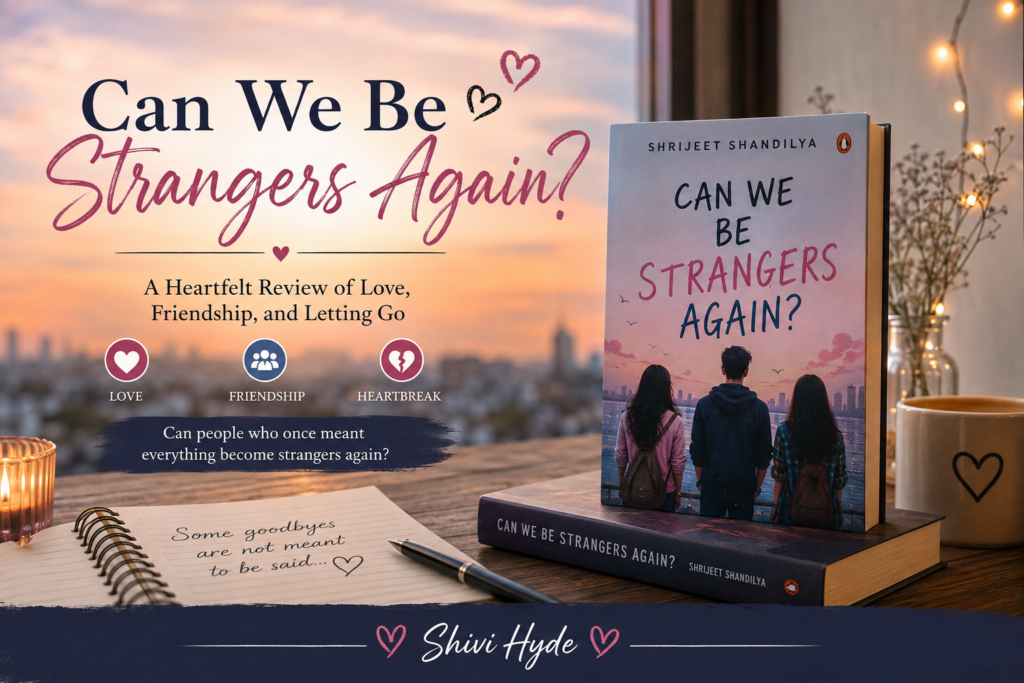
Can We Be Strangers Again? by Shrijeet Shandilya: A Heartfelt Review of Love, Friendship, and Letting Go
Some relationships don’t end with a dramatic goodbye.
Sometimes, they simply become different.
The person who once knew everything about you becomes someone you hesitate to text. The conversations that once lasted until 2 a.m. turn into awkward silence. And eventually, you find yourself wondering whether it would be easier if you had never met them at all.
That uncomfortable feeling sits at the heart of Can We Be Strangers Again? by Shrijeet Shandilya.
The novel is a contemporary romance centered around friendship, love, betrayal, heartbreak, and the complicated emotions that come with growing up. Originally published in 2023 and later published in India by Ebury Press/Penguin, the book runs for 232 pages.
But calling it simply a love story doesn’t quite capture what makes the book interesting. At its core, Can We Be Strangers Again? asks a much more difficult question: What happens when someone who was once an important part of your life becomes a stranger?
Can We Be Strangers Again? – Book Overview
Book: Can We Be Strangers Again?
Author: Shrijeet Shandilya
Genre: Contemporary Romance, Fiction
Publisher: Ebury Press
Length: 232 pages
Main Characters: Dev, Avantika, and Tanishka
The story revolves around three college friends—Dev, Avantika, and Tanishka.
Their friendship develops during the unusual period of online college and lockdowns. What begins with casual conversations gradually becomes something more complicated as friendship, attraction, love, and expectations start getting mixed together.
Dev finds himself caught in an emotional maze. His relationships with Avantika and Tanishka force him to question what he actually wants and whether he understands the difference between attraction, infatuation, friendship, and genuine love.
And that’s where the novel becomes more relatable than it might initially appear.
A Story About More Than Romance
At first glance, Can We Be Strangers Again? looks like another young-adult romance about college students falling in love.
And yes, romance is a major part of the story.
But underneath the romantic drama is something much more familiar: the fear of losing someone who once felt permanent.
Most people have experienced some version of this.
Maybe it was a school friend you stopped talking to after graduation. Maybe it was an ex you couldn’t imagine living without. Maybe it was someone you spoke to every day until, suddenly, you didn’t.
The strange thing about relationships is that people don’t always disappear completely. Sometimes they’re still around. You can see their name online. You might even know what they’re doing.
But the relationship itself is gone.
That’s the emotional space the novel explores.
The Story of Dev, Avantika, and Tanishka
The three central characters give the novel its emotional tension.
Dev
Dev is at the center of the story, and much of the narrative is experienced through his perspective. His emotional confusion drives many of the decisions that shape the story.
He’s far from perfect.
In fact, some readers may find his choices frustrating or immature. But that’s also part of what makes him believable as a young character trying to understand relationships without really knowing how relationships work.
Dev doesn’t always know what he wants.
And sometimes, people only understand what they had after they lose it.
Avantika
Avantika is another important part of Dev’s emotional journey.
The relationship between Dev and Avantika becomes complicated as expectations, attraction, and trust collide. Their story isn’t presented as a simple “boy meets girl” romance. Instead, it shows how quickly affection can become complicated when people aren’t honest with themselves or each other.
Tanishka
For many readers, Tanishka may be the character who stays in their mind after finishing the book.
She occupies a different emotional space in Dev’s life. Their friendship demonstrates how emotional intimacy doesn’t always come with an official relationship label.
Sometimes the person who listens to you, understands your worst days, and stays when everyone else leaves can become more important than the person you initially thought you loved.
That is one of the novel’s most interesting ideas.
Why the Pandemic Setting Matters
The novel takes place partly during the COVID-19 lockdown period, when college life, friendships, classes, and relationships were happening through screens.
That setting gives the story a distinctly modern feel.
Think about what college looked like during lockdown.
No crowded classrooms.
No random conversations in hallways.
No meeting friends between lectures.
Instead, relationships were built through messages, calls, video meetings, and late-night conversations.
For many young people, online communication became their entire social world.
The novel uses that environment to show how people could become emotionally close without physically spending time together.
And that feels especially relevant because the pandemic changed how an entire generation experienced friendship and relationships.
The Biggest Theme: Can People Really Become Strangers Again?
This is the question that gives the book its identity.
Imagine knowing someone’s favorite song, their insecurities, their family problems, their habits, their dreams, and the things they don’t tell anyone else.
Then imagine trying to treat that person like a stranger.
Can you actually do it?
Technically, yes.
Emotionally, it’s much harder.
Once someone has become a significant part of your life, you can’t completely erase the history you share with them.
You can stop talking.
You can delete old photographs.
You can unfollow them.
You can convince yourself that you’re over them.
But memories don’t work like social media accounts. You can’t simply press “delete.”
That’s why the title feels so powerful.
It isn’t really asking whether two people can stop talking.
It’s asking whether they can erase the emotional history between them.
Love vs. Infatuation
Another important idea in Can We Be Strangers Again? is the difference between love and infatuation.
When you’re young, intense feelings can easily feel like love.
You think about someone constantly.
You wait for their messages.
A five-minute conversation can make your entire day better.
You start imagining a future together.
But intensity doesn’t automatically mean love.
Sometimes it’s attraction.
Sometimes it’s loneliness.
Sometimes it’s the excitement of being wanted.
And sometimes it’s genuine love.
Figuring out which one you’re experiencing isn’t always easy.
Dev’s journey reflects that confusion. His experiences force him to confront the uncomfortable possibility that what he once considered love may not have been as simple as he thought.
Friendship Can Hurt More Than Romance
One of the strongest aspects of the novel is its focus on friendship.
Romantic breakups are often treated as the ultimate form of heartbreak. But losing a close friend can hurt just as much—and sometimes even more.
A romantic relationship comes with an understood possibility of ending.
Friendships often don’t.
You assume your best friend will remain your best friend.
Until one day, something changes.
Maybe someone falls in love.
Maybe someone moves away.
Maybe an argument goes too far.
Maybe both people simply grow into different versions of themselves.
And suddenly, the person who used to know everything about you is no longer part of your daily life.
That kind of loss can be incredibly difficult to explain.
A Simple Writing Style That Makes the Book Easy to Read
One reason the novel has found an audience among younger readers is its accessible writing style.
It isn’t written like a dense literary novel.
The language is straightforward, the chapters move quickly, and the emotional situations are easy to understand. Reader reactions are mixed—some appreciate the simplicity and relatability, while others feel that the writing can be repetitive or overly simple.
And honestly, whether that works for you will depend on what you’re looking for.
If you want elaborate prose and deeply layered literary characterization, this may not be your ideal romance.
But if you want something quick, emotionally familiar, and easy to follow, the writing can make the story approachable.
What Works Well in the Novel?
1. Relatable emotions
The strongest element of the novel is its emotional familiarity.
The awkward conversations, misunderstandings, attachment, jealousy, late-night chats, and uncertainty can feel very close to real-life relationships.
2. A contemporary setting
The pandemic-era college setting gives the novel a connection to a very specific period in recent history.
3. An interesting central question
The title itself creates curiosity.
Can people really go from knowing everything about each other to knowing nothing?
4. Easy readability
The novel doesn’t demand enormous amounts of time or concentration. At 232 pages, it’s also relatively short compared with many contemporary novels.
5. Emotional conflict
The story isn’t simply about whether two people will end up together. It’s about what happens when relationships overlap and emotions become difficult to categorize.
Where the Novel May Not Work for Everyone
It’s also worth being honest about the book’s limitations.
Reader opinions are quite divided.
Some readers praise its emotional relatability and simple writing, while others criticize the character development, repetitive sections, predictable elements, and narrative structure. Goodreads currently shows a mixed reception, with an overall rating around 3.37 based on thousands of ratings.
Some readers have also found the shifts between past and present confusing or felt that Dev’s character could have been developed more deeply.
So this isn’t necessarily a book that will work for everyone.
And that’s okay.
A book doesn’t have to be perfect to be meaningful to a particular reader.
Is Can We Be Strangers Again? Worth Reading?
If you enjoy Indian contemporary romance, college stories, friendship dramas, heartbreak, and emotionally complicated relationships, this novel is worth considering.
It’s especially suitable for readers who prefer:
- Simple and accessible writing
- College-based romance
- Friendship and relationship drama
- Emotional stories about heartbreak
- Contemporary Indian settings
- Shorter, fast-paced fiction
However, if you’re looking for extremely complex characters, sophisticated literary prose, or a highly unpredictable plot, you may find the book less satisfying.
What Makes the Novel Relatable?
Perhaps the biggest reason people connect with Can We Be Strangers Again? isn’t because the story is extraordinary.
It’s because the emotions are ordinary.
Most of us know what it’s like to miss someone.
Most of us know what it’s like to overthink a message.
Most of us have wondered whether someone still thinks about us.
And many of us have experienced a relationship that ended without giving us the kind of closure we wanted.
That’s where the novel finds its emotional strength.
It doesn’t necessarily tell us something we’ve never heard before.
Instead, it reminds us of things we’ve already felt.
Final Thoughts
Can We Be Strangers Again? by Shrijeet Shandilya is ultimately a story about what happens when love, friendship, and growing up collide.
It isn’t just about getting into a relationship.
It’s about what happens afterward.
It’s about mistakes.
It’s about choosing the wrong person.
It’s about realizing the value of someone too late.
It’s about friendships that become complicated.
And most importantly, it’s about learning that some people can leave your life without leaving your memories.
The title asks a simple question, but there isn’t a simple answer.
Can we really become strangers again?
Maybe we can stop calling.
Maybe we can stop meeting.
Maybe we can become strangers in every practical sense.
But emotionally?
That’s much harder.
Because once someone has been part of your story, you can’t completely rewrite the pages they were in.
And perhaps that’s the bittersweet message at the heart of Can We Be Strangers Again?: sometimes moving on doesn’t mean forgetting someone. It simply means learning how to remember them without needing them to stay.
Frequently Asked Questions
1. Who wrote Can We Be Strangers Again?
Can We Be Strangers Again? was written by Indian author Shrijeet Shandilya. It is his debut novel and explores themes of love, friendship, loss, and growing up.
2. What is Can We Be Strangers Again? about?
The novel follows Dev, Avantika, and Tanishka, three college friends whose relationships become complicated as friendship, love, attraction, and betrayal enter the picture. The story explores what happens when people who were once extremely close become emotionally distant.
3. What genre is Can We Be Strangers Again?
It is primarily a contemporary romance and fiction novel, with strong themes of friendship, heartbreak, relationships, and coming of age.
4. Is Can We Be Strangers Again? a good book for beginners?
Yes, it can be a good option for readers who are new to fiction because of its accessible language and relatively short length. However, readers who prefer complex literary fiction may find the writing too simple.
5. Is Can We Be Strangers Again? worth reading?
If you enjoy relatable college romance, friendship drama, heartbreak, and stories about complicated relationships, you may enjoy it. Reader opinions are mixed, so expectations matter. Some readers strongly connect with its emotional themes, while others criticize its character depth and repetitive storytelling.