The Fun They Had – Summary | CBSE Class 9 English
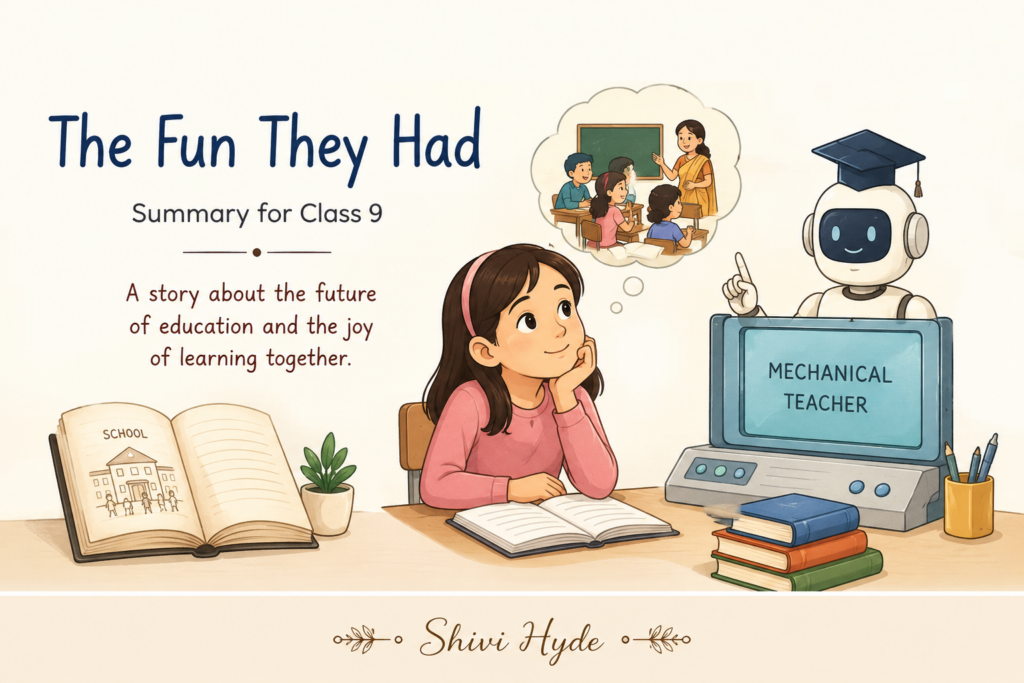
The Fun They Had is a fascinating science-fiction story written by Isaac Asimov. The story takes us to a future world where technology has completely changed the way children study. Instead of going to school, children attend classes at home with the help of mechanical teachers. Through the experiences of two children, Margie and Tommy, the author makes us think about the importance of friendship, human teachers, and learning together.
Introduction to the Story
The story takes place in the year 2157, when schools as we know them today no longer exist. Children study individually in their homes. They have mechanical teachers that teach different subjects, give tests, and assign homework.
The main character, Margie, is a thirteen-year-old girl. She dislikes her mechanical teacher because she has been performing badly in geography. Her teacher keeps giving her tests, and her marks continue to fall. Margie feels frustrated and wishes that the machine would stop for some time.
One day, Margie’s friend Tommy, who is eleven years old, finds something unusual in his house. He discovers an old-fashioned printed book. Tommy is excited because he has never seen a real book before.
The Old Book
Tommy shows the book to Margie. Both children find it strange because the pages are yellow and the words remain fixed on the pages. In their time, children normally read books on screens, where words can change and move.
Tommy tells Margie that the book is about schools from the past. Margie is surprised to learn that children once went to a special building called a school. She finds the idea difficult to understand because, in her world, children study at home with mechanical teachers.
Margie becomes curious about how children studied in the past. Tommy explains that students from the neighborhood went to school together. They studied the same subjects and were taught by human teachers.
Margie’s Mechanical Teacher
Margie does not like her mechanical teacher at all. She has been having problems with geography because the machine is giving her tests that are too difficult. Her mother becomes concerned and calls the County Inspector.
The Inspector comes to their house and examines the mechanical teacher. He discovers that the geography section has been adjusted too quickly for Margie’s level. He repairs the machine and slows it down to match her age.
Margie hopes that the mechanical teacher will be taken away completely, but the Inspector tells her mother that the machine is working properly. He also explains that Margie is not at fault and that her progress is normal.
After the Inspector leaves, Margie continues her lessons. However, she remains unhappy with the way she has to study.
A Different Kind of School
The conversation between Margie and Tommy makes Margie imagine what schools in the past must have been like.
She learns that children of the same age studied together. They had human teachers who taught them lessons and interacted with them. Margie finds this very unusual because she has never experienced such a classroom.
In her world, every child has a mechanical teacher at home. The lessons are adjusted according to the child’s level, and there is no classroom where children can sit together.
Margie remembers that her mother once told her about her grandfather’s grandfather, who had been taught by a human teacher. However, Margie cannot fully understand how such a system could work.
The Importance of Friends and Human Teachers
As Margie thinks about the old schools, she begins to imagine children studying together, laughing, playing, and helping one another with their lessons.
She realizes that children in the past must have enjoyed learning because they were able to spend time with their friends. They could talk during breaks, share ideas, and experience school life together.
Margie and Tommy, on the other hand, have to study separately in their homes. Their mechanical teachers may be efficient, but they cannot provide the warmth, emotions, encouragement, and companionship of human beings.
This contrast is the heart of the story. The author does not simply criticize technology. Instead, he encourages readers to think about how technology should be used in education without taking away the human side of learning.
Ending of the Story
At the end, Margie returns to her lesson because her mechanical teacher is waiting for her. However, her thoughts remain focused on the old schools.
She imagines the children from the past entering a school building together, sitting in the same classroom, learning from a human teacher, and spending time with their friends.
Margie thinks about how much fun those children must have had. This thought gives the story its title, “The Fun They Had.”
The title is meaningful because Margie begins to understand that the children of the past had something that she and Tommy did not have—the joy of learning together.
Themes of The Fun They Had
The story explores several important themes:
1. Technology and Education
The story shows how technology can change education. Mechanical teachers can provide personalized lessons, but they cannot completely replace human interaction.
2. Importance of Human Connection
Learning is not only about books, tests, and marks. Interaction with teachers and classmates also helps children grow emotionally and socially.
3. Traditional vs. Modern Education
Asimov presents a comparison between future technology-based education and traditional classroom education. The story makes us appreciate the positive aspects of studying together.
4. Friendship and Happiness
Friends make learning more enjoyable. Sharing experiences, playing together, and helping each other create memories that machines cannot provide.
Message of the Story
The Fun They Had teaches us that technology can make education easier and more personalized, but human interaction remains extremely important. A good education should develop not only knowledge but also communication, friendship, creativity, and emotional understanding.
Isaac Asimov’s story encourages us to value our schools, teachers, and classmates. It reminds us that sometimes the things we take for granted—such as sitting in a classroom with friends—may actually be the most enjoyable part of learning.
Conclusion
The Fun They Had is a simple yet thought-provoking story that connects the future with the present. Through Margie and Tommy, Isaac Asimov shows us a world where advanced technology has replaced traditional schools. Although the children have access to sophisticated mechanical teachers, Margie begins to realize that something important is missing.
The story leaves us with a beautiful thought: education is not only about learning from a teacher or machine; it is also about sharing the experience with other people. The laughter, friendship, classroom activities, and human connection of traditional schools are what made learning truly enjoyable.
That is why Margie looks back at the old schools and wonders about “the fun they had.”